Posts

Showing posts with the label rfid tags

Streamlining Warehouse Management with RFID Tags

Image
 Efficient warehouse management is the backbone of modern supply chains. Businesses today need faster operations, accurate inventory control, and real-time tracking to keep up with market demand. This is where RFID tags are transforming the way warehouses operate, enabling companies to cut costs, save time, and boost productivity. What Are RFID Tags and Why Do They Matter? An RFID tag is a small electronic device that stores data and communicates wirelessly through radio frequency. Unlike barcodes that require a scanner to be in direct line of sight, RFID tags can be read at a distance and in bulk. This simple difference translates into massive efficiency gains when managing large volumes of products inside warehouses. For example, inventory counts that previously took hours can now be completed in minutes with RFID-enabled systems. This means fewer errors, less manual effort, and more accurate data for decision-making. Benefits of Using RFID in Warehouse Operations Warehouses fac...

The Secret Behind Fast Checkouts and Smart Shelves? RFID Tags

Image
Customers now expect a seamless and convenient shopping experience more than ever in today's highly competitive retail landscape. From minimising wait times to stocking shelves with the right products, retailers are constantly searching for ways to improve efficiency and enhance the customer experience. RFID tags — an incredible technology revolutionising retail — are making checkouts faster, shelves smarter, and operations more streamlined than ever.   However, how exactly are RFID tags accomplishing all this? Let's delve into how RFID technology is revolutionising retail.   1. What Are RFID Tags and How Do They Work?   RFID (Radio Frequency Identification) tags are small, inexpensive devices that use radio waves to identify and track objects automatically. Each tag features its microchip and antenna that stores information about the object attached to it; when an RFID reader sends out radio waves, the tag responds by transmitting this information back and quick...

The Role of RFID Tags in Enhancing Security Across Various Industries

Image
  RFID systems automatically recognise and record data without direct line-of-sight, saving both time and money while increasing efficiency. They offer real-time inventory management to safeguard against theft or misplacement of items. RFID tags are small devices fitted with microchips and antennas designed to transmit radio waves when within range of an RFID reader.   RFID technology can be applied across industries to streamline and optimise processes, from manufacturing to healthcare. RFID tags in manufacturing enable tracking components or products during the entire production line process, ensuring every piece is counted and production schedules adhered to.   RFID tags offer retailers real-time inventory management, helping eliminate out-of-stocks and shrinkage while increasing sales and customer satisfaction. Furthermore, this technology enables integration between online sales channels and in-store sales channels as well as simplified return shipments. ...

RFID Tags in Healthcare: Enhancing Patient Safety and Asset Management

Image
  The top two priorities for the healthcare industry are quality patient care and efficient asset management. As hospitals and other healthcare facilities grow and become more and more busy with the influx of patients and equipment, the need for effective tracking and management systems is greater than ever. That’s where RFID (Radio Frequency Identification) technology enters the picture. Radiofrequency identification tags are increasingly being hailed as a game changer in healthcare, giving hospitals powerful new ways to optimize their work, minimize human error and improve patient care. RFID technology is slowly entering the healthcare scenario, from monitoring patients to tagging medical devices. 1.Enhancing Patient Safety through the use of RFID Tags Safety of patients always comes first in every setting of health. Regrettably, identification and drug administration errors may result in catastrophic outcomes for the patients. RFID technology can be used to address this problem,...

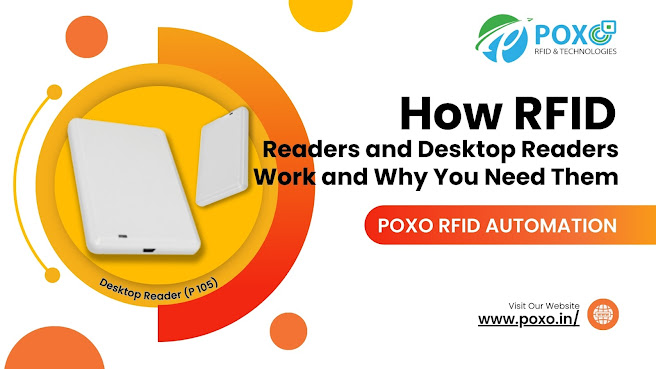
How RFID Readers and Desktop Readers Work and Why You Need Them - POXO

Image
In today's world, technology is advancing quickly. One exciting tool that's making a big impact is Radio-Frequency Identification (RFID) technology. It's changing the way we keep track of things. At the heart of this technology are RFID readers , and among them, desktop readers are really important. Understanding RFID Technology: 1. Basics of RFID: RFID readers are devices that communicate with RFID tags to capture data stored within them. These tags contain a unique identifier that can be read by the reader using radio waves. The reader emits radio frequency signals, which power the tag and enable it to transmit its information back to the reader. 2. RFID Tags: RFID tags are small devices equipped with a unique identifier and an antenna. They come in various forms, such as passive (powered by the reader's signal) or active (with an on-board power source). These tags store information that can be read by an RFID reader.   3. RFID Readers: RFID readers ...

How RFID Smart Cards Are Changing the Way We Access Things- POXO

Image
    In a world filled with technological wonders, one innovation that's quietly making our lives easier is the RFID smart cards . You might not have heard much about them, but these little cards are changing the way we access all sorts of things, from our workplace to public transportation and even our homes. Let's dive in and explore how these smart cards are making our lives more convenient.   What is an RFID Smart Card? First things first, let's demystify what RFID smart cards are. RFID stands for Radio-Frequency Identification, but don't let the technical jargon scare you. Essentially, an RFID smart card is like a magic key that uses radio waves to communicate with a special reader. This reader can be a device, a sensor, or even a smartphone. When the card gets close to the reader, it sends a signal, and voila! Doors open, payments are made, and access is granted.   Accessing the Workplace One of the most common uses of RFID smart cards is in the workplace. Ins...